Castor Bean
Ricinus Communis

Medicinal Facts
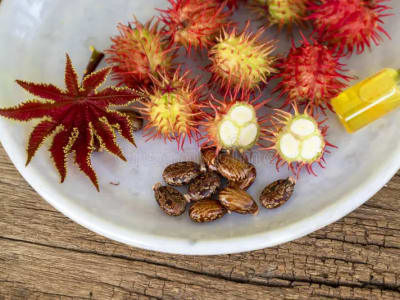
Ricinus communis, commonly known as Castor Bean, is primarily recognized for its potent compound ricin, a highly toxic protein, and ricinoleic acid, the active component of castor oil. This plant occupies a unique space at the intersection of traditional medicine, where castor oil is used as a laxative and for skin health, and toxicology, due to the deadly nature of ricin. Modern research also explores its potential in industrial applications and its anti-inflammatory properties, particularly focusing on ricinoleic acid's effects on prostaglandin synthesis.
What it helps with
Constipation
Ricinoleic acid, the active component of castor oil, acts on the EP3 prostanoid receptor to stimulate intestinal peristalsis, thereby exerting its laxative effect. This mechanism has been supported by human trials demonstrating its efficacy in short-term constipation relief, though its use is limited by potential side effects such as cramping.
Inflammation & pain
Ricinoleic acid inhibits the production of prostaglandins E2 and F2, which are key mediators of inflammation. This anti-inflammatory action is primarily supported by in vitro studies and traditional use in topical applications for conditions like arthritis and muscle pain.
Skin health & wound healing
Castor oil, rich in ricinoleic acid, promotes wound healing through its antimicrobial properties and its ability to enhance the epithelialization process. It also modulates the local inflammatory response, making it beneficial in traditional skin care practices.
Hair growth & scalp health
Traditionally, castor oil is used to promote hair growth and improve scalp health. Ricinoleic acid increases prostaglandin E2 levels in hair follicles, potentially stimulating hair growth, though clinical evidence remains limited.
Antimicrobial activity
Ricinoleic acid exhibits antimicrobial properties by disrupting microbial cell membranes and inhibiting bacterial growth. This has been observed in vitro against various pathogens, supporting its traditional use in treating minor skin infections.
Immune modulation
Castor oil has been traditionally used to support immune function. Ricinoleic acid may modulate immune responses by affecting cytokine production, though this mechanism is primarily understood from preclinical studies.
Detoxification protocols
In traditional medicine, castor oil is used in detoxification protocols to enhance lymphatic circulation and support the liver. The exact mechanisms are not well-defined but may involve ricinoleic acid's influence on prostaglandin pathways and lymphocyte activity.
Key active compounds
Ricinoleic acid
A hydroxylated fatty acid responsible for the laxative and anti-inflammatory properties of castor oil. It acts on prostanoid receptors and modulates prostaglandin synthesis.
Ricin
A highly toxic protein that inhibits ribosomal function by depurinating adenine residues in rRNA, leading to cell death. Its toxicity limits the use of raw castor beans.
Ricinine
An alkaloid present in the plant that has shown insecticidal properties. It binds to nicotinic acetylcholine receptors, disrupting neural transmission in pests.
Linoleic acid
An essential fatty acid present in castor oil, contributing to skin barrier function and anti-inflammatory effects through modulation of eicosanoid pathways.
Oleic acid
A monounsaturated fatty acid that enhances skin permeability and has been shown to have anti-inflammatory properties by modulating cytokine production.
Stearic acid
A saturated fatty acid that contributes to the emollient properties of castor oil, aiding in skin hydration and protection.
Diterpenes
Compounds that may contribute to the plant's antimicrobial and insecticidal properties, though their specific mechanisms in humans are less well-characterized.
What the research says
Research on Ricinus communis is heavily bifurcated between its toxicological aspects due to ricin and its medicinal uses, particularly of castor oil. Ricinoleic acid has the strongest evidence for its laxative and anti-inflammatory effects, supported by both traditional use and small human trials. The antimicrobial and skin health benefits are primarily supported by in vitro studies and anecdotal evidence. The main limitation of castor oil's medicinal use is the potential for gastrointestinal discomfort and the risk of ricin exposure, which is mitigated by using processed oil free of the protein. Industrial applications of its compounds, particularly in biopesticides and biofuels, are also a growing area of research.
Typical dosage
For laxative use, adults can take 15-60 mL of castor oil orally, ideally under medical supervision due to its potent effects. For topical applications, a small amount of castor oil can be applied directly to the skin or hair, once or twice daily. It is crucial to avoid contact with eyes and to perform a patch test to check for allergic reactions.
About Castor Bean
Traditional Use
Preparations & Dosage
Preparations
- Poultice: Soak a cloth in warm castor oil and apply to the affected area. Cover with plastic wrap and apply heat for 30-60 minutes.
Use only commercially processed castor oil. Never press or extract oil from the seeds yourself: the seeds contain ricin, which has no antidote and is frequently fatal, and home pressing does not reliably remove it. Stop use and seek medical help for severe abdominal pain, vomiting or bloody diarrhoea.
- Topical application: Apply a small amount of castor oil directly to the skin or scalp. Massage gently until absorbed.
Use only commercially processed castor oil. Never press or extract oil from the seeds yourself: the seeds contain ricin, which has no antidote and is frequently fatal, and home pressing does not reliably remove it. Stop use and seek medical help for severe abdominal pain, vomiting or bloody diarrhoea.
Interactions & Warnings
Use with caution
Ricinus communis contains ricin, a highly toxic compound, especially in its seeds. Consumption of seeds or improper handling can lead to severe poisoning or death. Pregnant women, children, and individuals with compromised health should avoid using products derived from this plant without professional guidance.
Herb Interactions
May increase the risk of photosensitivity when applied topically.
Community Plants
Real plants of this species grown and shared by the MyFloralVault community.
More in Digestive Health




Was this helpful?
0 · 0